

how to draw an indifference curve from a utility function
What is an Indifference Curve?
An indifference curve is a contour line where utility remains abiding across all points on the line. In economics, an indifference curve is a line drawn between unlike consumption bundles, on a graph charting the quantity of good A consumed versus the quantity of good B consumed. At each of the consumption bundles, the individual is said to be indifferent.

Summary
- An indifference curve is a contour line where utility remains abiding beyond all points on the line.
- The four properties of indifference curves are: (i) indifference curves can never cross, (2) the farther out an indifference curve lies, the college the utility it indicates, (3) indifference curves always slope down, and (4) indifference curves are convex.
- The optimal consumption bundle is the tangency condition between the indifference curve and the budget line.
What is Utility?
When an private consumes goods and services , the satisfaction gained or lost from consumption is called utility. Consumer preferences are divers by the consumption bundles that consumers face. A collection bundle is a bundle that maximizes the consumer'south total utility, given the consumer's budget constraints. One unit of utility is known every bit a util.
The Principle of Diminishing Marginal Utility
Marginal utility refers to the utility gained from the consumption of an additional unit of measurement of a practiced or service.
The principle of diminishing marginal utility is illustrated hither as the total utility increases at a diminishing rate with additional consumption. It is evidenced by figures D, E, and F having decreased marginal utility. Therefore, the principle of diminishing marginal utility indicates that each boosted unit of consumption adds less to the cumulative utility than the previous unit.

What Does an Indifference Curve Look Like?
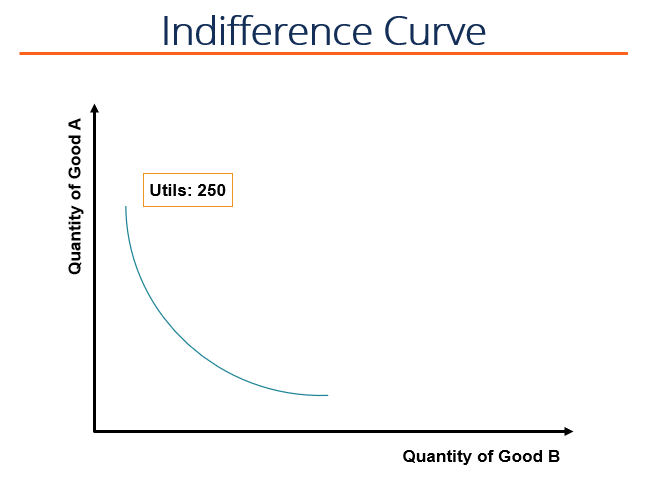
An indifference curve is a profile line where utility remains constant across all points on the line. Each betoken on an indifference bend represents a consumption bundle, and the consumer is indifferent among all consumption bundles on the indifference curve. In our example, the consumer yields 250 utils.
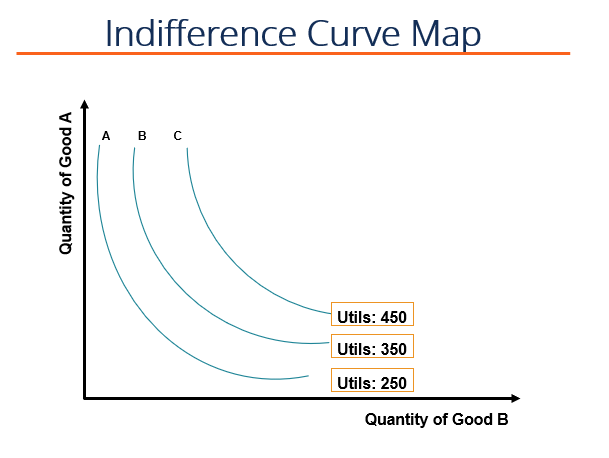
An unabridged utility part tin can exist graphically represented by an indifference curve map, where several indifference curves represent to unlike levels of utility. In the graph below, there are three different indifference curves, labeled A, B, and C. The farther from the origin, the greater utility is generated across all consumption bundles on the curve.
Backdrop of Indifference Curves
If a good satisfies all four properties of indifference curves, the goods are referred to equally ordinary goods. They can be summarized equally the consumer requires more of one good to compensate for less consumption of another good, and the consumer experiences a diminishing marginal rate of substitution when deciding betwixt 2 goods.
- Indifference curves never cross. If they could cross, it would create large amounts of ambiguity as to what the true utility is.
- The further out an indifference curve lies, the farther it is from the origin, and the higher the level of utility information technology indicates. As illustrated above on the indifference bend map, the further out from the origin, the more utility the private generates while consuming.
- Indifference curves gradient downward. The only way an individual can increase consumption in one expert without gaining utility is to eat another practiced and generate the same corporeality of utility. Therefore, the slope is downwardly sloping.
- Indifference curves assume a convex shape. Every bit illustrated above in the indifference curve map, the curve gets flatter as you move down the bend to the correct. It illustrates that all individuals experience diminishing marginal utility, where additional consumption of another good will generate a lesser amount of utility than the prior.
What Defines the Convexity of Indifference Curves?
As you lot go down the curve of an indifference curve, the curve becomes flatter as one good is substituted for the other. Information technology is the individual'south marginal rate of commutation, which is defined every bit the more an individual consumes good A in proportion to good B, the less of skilful B the private will substitute for another unit of expert A.
The Optimal Consumption Bundle
In the graph below, point A illustrates the tangency status the utility curve has with the budget line constraint.
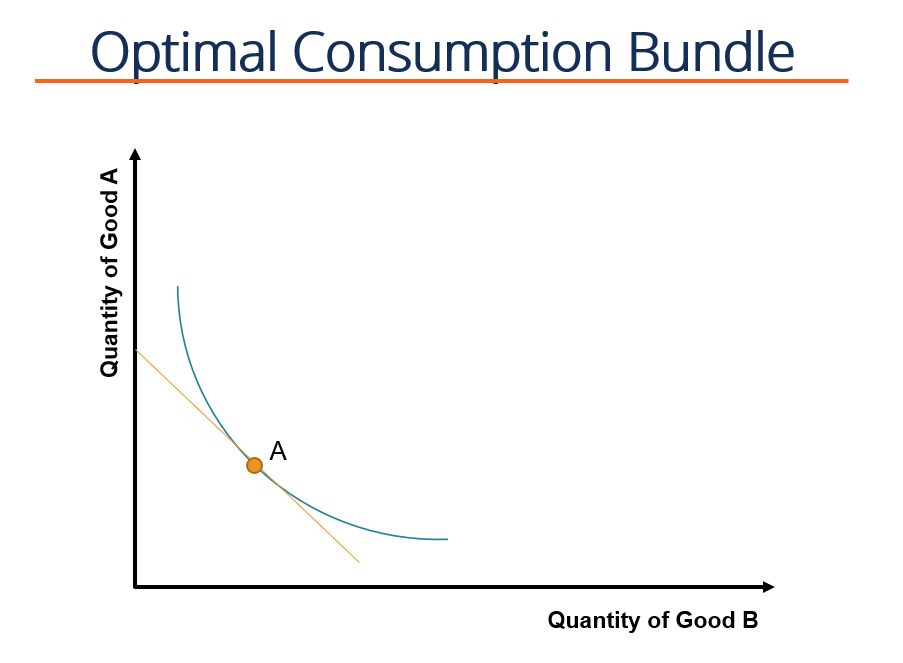
The tangency condition betwixt the indifference curve and the budget line indicates the optimal consumption bundle when indifference curves exhibit typical convexity.
Slope of the Upkeep Line
The gradient of the budget line is the relative price of adept A in terms of expert B, equal to the price of good A as a ratio of the market price of good B. Moreover, the slope of the upkeep line subtracted by relative cost represents the opportunity cost of consumption. There is an opportunity cost considering of the consumer'due south express upkeep. The upkeep line is shifted outwards by the price of goods condign proportionally cheaper.
Slope of the Indifference Bend
The slope of the indifference bend at any signal is the negative marginal utility of proficient A equally a proportion of the marginal utility of practiced B. It indicates that the optimal consumption bundle – the marginal charge per unit of substitution betwixt goods A and B – is the ratio of their prices.
Boosted Resources
CFI is the official provider of the global Commercial Banking & Credit Analyst (CBCA)™ certification program, designed to help anyone become a world-class financial analyst. To keep advancing your career, the additional resource below volition exist useful:
- Aggregate Supply and Demand
- Conspicuous Consumption
- Marginal Propensity to Consume
- Yield Curve

Source: https://corporatefinanceinstitute.com/resources/knowledge/economics/indifference-curve/
Posted by: palmerbutcheall.blogspot.com
0 Response to "how to draw an indifference curve from a utility function"
Post a Comment